Workers assume machinery is safe when it’s off. It’s not. Every year, preventable injuries and fatalities occur during maintenance because energy sources weren’t properly controlled. The root cause? A breakdown in communication, procedure, or awareness—exactly where a lockout tagout safety toolbox talk becomes critical.
These short, focused safety meetings aren’t just routine. They’re a frontline defense against electrocution, crushing, burns, and unexpected startup. When done right, LOTO toolbox talks reinforce procedures, uncover gaps, and align teams on real risks present during servicing and maintenance.
This guide breaks down what makes a LOTO toolbox talk effective, not just compliant. You’ll learn how to structure it, common pitfalls to avoid, and real-world applications that stick.
What Is a Lockout Tagout Toolbox Talk?
A lockout tagout safety toolbox talk is a brief, informal safety meeting held with workers before beginning maintenance, repair, or servicing activities on machinery or equipment. The goal is to communicate the hazards of unexpected energization and reinforce the correct application of lockout tagout (LOTO) procedures.
Unlike full-length training sessions, toolbox talks last 10–15 minutes and focus on a single, relevant topic—like verifying zero energy state, using personal locks, or handling group lockouts. They are designed to be timely, conversational, and directly applicable to the day’s work.
Why it's not optional: OSHA’s standard 29 CFR 1910.147 requires employers to conduct periodic inspections of LOTO procedures—at least annually—and to retrain employees when procedures change or deviations occur. Toolbox talks are a practical way to fulfill these requirements while keeping safety top of mind.
Real example: At a Midwest manufacturing plant, a maintenance crew was preparing to replace a motor on a conveyor. Before starting, the supervisor held a 12-minute toolbox talk reviewing the specific energy sources (electrical and gravity), the isolation points, and who would apply locks. One technician spoke up, noting the hydraulic line hadn’t been bled. That catch prevented a potential high-pressure fluid release.
Small meetings. Big impact.
Why Most LOTO Talks Fail (And How to Fix Them)
Many toolbox talks become check-the-box exercises. They’re delivered by rote, ignored by workers, or disconnected from actual job tasks. Here’s why they fail—and how to fix it.
#### 1. Generic Content, Not Job-Specific Reading from a script about “general LOTO safety” doesn’t help a mechanic working on a hydraulic press.
✅ Fix: Tailor the talk to the equipment, energy sources, and personnel involved. Use the machine’s name, location, and recent history.
#### 2. One-Way Communication When only the supervisor talks, engagement drops. Workers tune out.
✅ Fix: Ask questions. “Who here has applied a lock on this machine before?” “What could go wrong if we skip testing for zero energy?”
#### 3. Poor Timing Holding a LOTO talk an hour before work means key details are forgotten.
✅ Fix: Conduct the talk immediately before work begins, at the equipment location.
#### 4. No Accountability If no one documents or follows up, the talk has no weight.
✅ Fix: Document attendance, topic, and key points. Address recurring issues in future talks.
#### 5. Assuming Knowledge Supervisors often assume everyone understands LOTO. But turnover, subcontractors, or language barriers can create dangerous gaps.
✅ Fix: Verify understanding. Have a worker explain the steps aloud.
Structure of an Effective LOTO Toolbox Talk
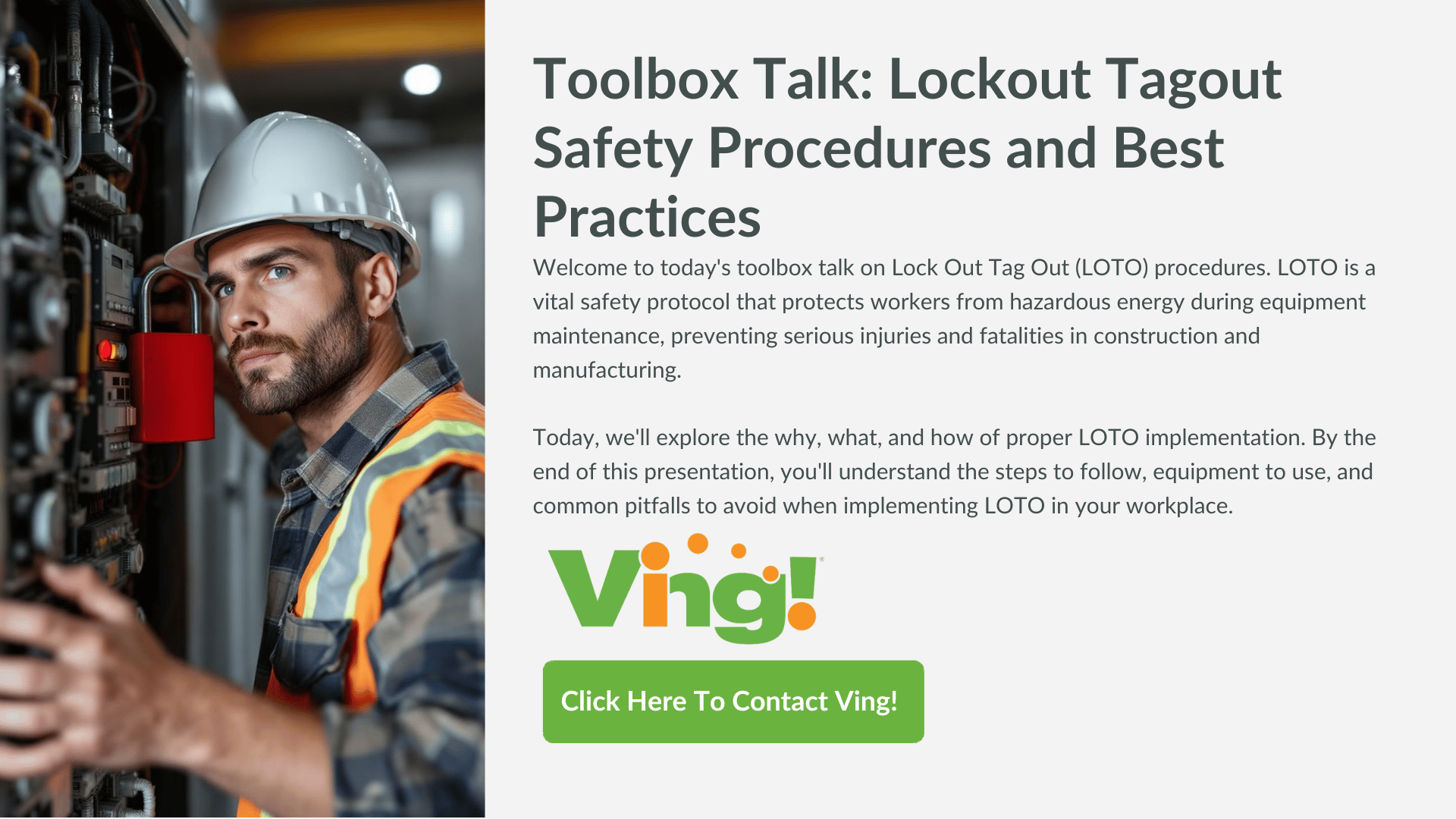
A consistent format keeps talks focused and impactful. Use this framework:
#### 1. Call to Attention (1 min) Start with a real incident or a direct question: “Did you know 10% of workplace fatalities involve uncontrolled energy? Today, we’re focused on preventing that—right here, right now.”
#### 2. Review the Task and Equipment (2 min) Name the machine, task, and energy types involved. Example: > “We’re cleaning the die press. Energy sources: electrical, hydraulic, and stored energy in the ram springs.”
#### 3. Walk Through LOTO Steps (4 min) Break down the procedure step-by-step: - Notify affected employees - Shut down the machine properly - Isolate all energy sources - Apply lockout devices - Dissipate stored energy - Verify zero energy state (test it!)
Use visual aids if possible—photos, lock types, or a quick demo.
#### 4. Discuss Hazards and Near Misses (3 min) Share a recent incident or near miss. Example: > “Last month, a worker in Plant B started a saw after lockout was removed—but didn’t check if others had locks on. That’s why we verify before restoring power.”
#### 5. Q&A and Confirmation (2 min) Ask: - “Who is the authorized employee applying locks?” - “Where are the isolation points?” - “What’s your procedure if someone leaves their lock on?”
Have team members respond. Confirm understanding.
#### 6. Document and Sign Off (1 min) Record the date, topic, attendees, and key takeaways. Keep it on file for OSHA audits.
Common LOTO Mistakes Highlighted in Toolbox Talks
Even experienced workers make errors. Use toolbox talks to spotlight these frequent issues:
#### ❌ Using Tags Without Locks Tags alone don’t isolate energy. They’re warnings, not barriers. Fix: Always use a lock where possible. If a lock can’t be used, follow a documented exception procedure with enhanced safeguards.
#### ❌ Skipping Verification Assuming the machine is de-energized is a deadly mistake. Fix: Test every circuit, line, or component. Use a voltage tester. Confirm movement is impossible.
#### ❌ Group Lockout Confusion Multiple workers on one machine? Each must apply their own lock. Fix: Use a group lockout box. The machine stays locked until every individual removes their lock.
#### ❌ Removing Locks for Others Only the person who applied a lock should remove it—no exceptions. Fix: If the worker is unavailable, follow the employer’s formal removal procedure, including management approval and verification.
#### ❌ Ignoring Stored Energy Springs, capacitors, gravity, pressurized lines—these can release energy even after shutdown. Fix: Bleed, block, or drain stored energy before work begins. Document the method in the LOTO procedure.
Real-World LOTO Toolbox Talk Scenarios
Use these examples to make talks relatable and actionable.
#### Scenario 1: Conveyor System Maintenance Task: Replace drive belt Energy sources: Electrical, rotating parts, gravity Talk focus: - Isolate motor disconnect and lock it. - Block rollers to prevent belt movement. - Verify no one is in the tunnel before resetting. Key question: “Who checks that all tools are clear before unlocking?”

#### Scenario 2: Hydraulic Press Repair Task: Replace cylinder seal Energy sources: Hydraulic pressure, electrical, gravity (ram) Talk focus: - Close and lock hydraulic valves. - Lower ram and support with safety blocks. - Bleed pressure lines before disconnecting. Mistake to highlight: “Never rely on the control valve alone to isolate fluid energy.”
#### Scenario 3: Contractor Work on a Boiler Task: Burner inspection Energy sources: Gas, electrical, heat, pressure Talk focus: - Lock main gas line and electrical disconnect. - Vent and purge before entry. - Use contractor lockout log. Critical rule: “Contractors use their locks. Our team verifies isolation.”
Tools and Resources to Support LOTO Talks
Equip your safety leaders with these practical tools:
| Tool | Purpose | Best Use Case |
|---|---|---|
| LOTO Procedure Templates | Standardize steps per machine | Developing site-specific plans |
| Lockout Kits (Padlocks, Hasps, Tags) | Physical isolation | Daily maintenance tasks |
| Energy Source Maps | Visual guides showing isolation points | Training and quick reference |
| Digital Checklists (Tablet/App) | Track compliance and verification | High-turnover or multi-site operations |
| Incident Flash Cards | Share real near misses | Spark discussion during talks |
Bonus tip: Print small laminated cards with LOTO steps and attach them near machines. Workers glance at them before starting—a silent reinforcement of the talk.
Making LOTO Talks a Cultural Habit
The best programs don’t mandate toolbox talks. They make them expected, valued, and worker-driven.
- Rotate who leads the talk—empowers team ownership.
- Recognize workers who speak up about safety gaps.
- Tie LOTO compliance to performance reviews (for supervisors).
- Review talk logs monthly—look for trends, not just signatures.
One automotive parts facility reduced LOTO incidents by 73% in 18 months simply by having workers lead every third talk. The shift in ownership changed behavior.
Closing: Turn Awareness Into Action
A lockout tagout safety toolbox talk shouldn’t be a monologue. It should be a moment of connection—between procedure and practice, between risk and reality.
Tomorrow’s maintenance task starts with today’s conversation. Make it specific. Make it interactive. Make it count.
Before any machine is opened, every worker should know: - Where the energy comes from - How it’s controlled - Who applied the lock - And how zero energy is verified
That clarity doesn’t come from a manual. It comes from consistent, focused, human-centered talks.
Start tomorrow’s shift with one question: “Have we locked it out, tagged it, and proven it’s safe?”
Then ensure the answer is always yes.
FAQ
What should be included in a LOTO toolbox talk? Cover the equipment, energy sources, step-by-step isolation, verification, and roles. Include a real example or near miss to drive the point home.
How often should LOTO toolbox talks be held? Before any servicing or maintenance involving energy isolation. For recurring tasks, conduct them each time—especially if personnel or conditions change.
Who can lead a LOTO toolbox talk? Any authorized employee familiar with the procedure. Supervisors, safety officers, or experienced technicians can lead, but worker participation is key.
Do contractors need to attend LOTO toolbox talks? Yes. Contractors must be included and use their own locks. The host employer is responsible for ensuring they understand and follow site LOTO procedures.
Can a LOTO talk replace formal LOTO training? No. Toolbox talks reinforce training but don’t substitute for initial or annual certification. They are part of an ongoing safety program.
Should LOTO talks be documented? Yes. Record the date, topic, attendees, and key points. Documentation supports compliance and continuous improvement.
What’s the biggest risk of skipping a LOTO toolbox talk? Miscommunication. Workers may assume isolation is complete when it’s not—leading to unexpected startup, serious injury, or fatality.
FAQ
What should you look for in Lockout Tagout Safety Toolbox Talk Essentials? Focus on relevance, practical value, and how well the solution matches real user intent.
Is Lockout Tagout Safety Toolbox Talk Essentials suitable for beginners? That depends on the workflow, but a clear step-by-step approach usually makes it easier to start.
How do you compare options around Lockout Tagout Safety Toolbox Talk Essentials? Compare features, trust signals, limitations, pricing, and ease of implementation.
What mistakes should you avoid? Avoid generic choices, weak validation, and decisions based only on marketing claims.
What is the next best step? Shortlist the most relevant options, validate them quickly, and refine from real-world results.